


Capital Market Line: A Passing Energy Shock Meets a Lasting Productivity Surge

Michael J. Kelly, CFA
Global Head of Multi-Asset

Hani Redha, CAIA
Portfolio Manager, Head of Strategy and Research for Global Multi-Asset

Steven Lin, CFA
Portfolio Manager, Global Multi-Asset

Peter Hu, CFA, FRM
Portfolio Manager, Global Multi-Asset

Sunny Ng, CFA
Portfolio Manager, Global Multi-Asset

Mikhail Johaadien
Research Analyst, Global Multi-Asset

Teresa Wang
Vice President, Research Analyst, Global Multi-Asset

The fate of the Strait of Hormuz will likely remain a key variable for global markets for much of 2026. Looking out a bit further, “the cure for high prices is high prices” should again become the reality, at least for commodities like oil. Most countries’ energy intensity has dropped since the last energy shock, with societies putting meaningful clean energy sources in place and, more recently, rediscovering nuclear energy as a clean and steady source of power ideal to fuel AI. Venezuela will also soon begin to close the gap between its vast oil reserves (actually the largest in the world) and its relatively small production. That wasn’t the case before Chavez took over. This isn’t to say that energy normalization will be seamless; interim stagflation may arise from structural damage to energy-intensive products and supply chains during the war. While the escalation was fast and vertical, the de-escalation is likely to be jagged and slow.
Before the Iran war, markets were already preparing to finance the largest investment wave in history for AI on top of a structural rise in fiscal spending in relation to GDP. The private sector is already investing in supply chain shifts, a remix toward cleaner forms of energy, and AI buildouts. Future spending will also now go toward repairing damaged energy and other infrastructure in the Middle East, rebuilding Ukraine, and, for many countries, upping defense outlays after years of underinvestment. Investment demands of this magnitude seem destined to add a layer of capital-intensive growth that hasn’t been witnessed in decades, thus shrinking the global savings glut, creating a slow upward trend in real rates (particularly at the long end), as well as boosting productivity and perhaps even spurring disinflation once this supply-led backdrop has been in place long enough.
While clarity is still elusive, markets are sure to remain forward-looking and drawn to change at the margins. Baseline forecasts for global growth now broadly show a deceleration back to trend from an above-trend pace as a result of the Iran conflict, with inflation remaining elevated through at least midyear before beginning a gentle and perhaps secular decline as productivity rises. The anniversary of tariff pass-throughs will segue into a decline in goods inflation in the second half of 2026, though slowed by the lingering impact of the Iran conflict on energy prices. Inflation moves will be determined largely by decelerating US shelter costs and accelerating AI-driven service disinflation. In a service economy, these two forces could be quite consequential and are likely to break in a long-lasting disinflationary manner, in our view.
We expect to see an uptick in both real rates and productivity, not only from the impact of AI but also from the sheer quantity of investments from so many angles. Over the medium term, this should nurture a supply-led environment that drives inflation lower. Those who anticipate mean-reversion may continue to place their chips on a glide-path toward lower profitability. Instead, we believe that given today’s setup, these powerful forces look poised to push return on invested capital (ROIC) higher for many years – that is, until society intervenes to control the pace of change and likely concentration of income and wealth resulting from AI. In the interim, as the return to capital rises, we see this process boosting equity fair value for years to come while containing spreads at today’s narrow levels. These conditions are conducive to risk-taking and continued carry.
In pricing this market backdrop, we must decide how to weight the various dominant shocks ahead of us. Should we remain anchored by a potentially slow, negative de-escalation of the Iran conflict, where the debate centers on its magnitude and duration? Or focus on what lies beyond – a burgeoning and predominantly positive productivity shock, which, while not yet here, is rapidly approaching? Here, the debate balances societal implications with upwardly trending ROIC and real rates and lower-productivity-induced disinflation. This debate is predominantly about the magnitude and speed of AI’s ascendence. Though all eyes have been glued to the Iran conflict, the AI-driven pace of change and pulling-forward of productivity has been breathtaking. Agentics landed much sooner than expected, courtesy of Anthropic, which has caught the attention of enterprises. Game on.
Prior to Iran, markets had rotated away from capital-intensive US hyperscalers that lacked visibility into if and when revenues would kick in to pay for this spending, with these hyperscalers dominating US indices. This sparked a move away from the US toward emerging countries and Europe, where conditions were improving on the margin. Since Iran, the landscape appears to favor a reconsideration. Asia and Europe will experience more of an energy hangover, while the US’s self-sufficiency is being recognized just as revenues from hyperscaler investments are set to appear, justifying the tremendous capital outlays.
While the investment cycle in AI should continue at least through 2027, it has begun to moderate. OpenAI revised its investment outlook down sharply, to a cumulative $600 billion by 2030 from earlier open-ended ambitions of $1.4 trillion – perhaps the first sign of rationalization in hyperscalers’ ever-expanding capital expenditures. These buildouts, which propelled “pickaxe and shovel” beneficiaries in the early AI gold rush, are now meeting scrutiny around return on invested capital. The market narrative is evolving quickly: where last year it celebrated AI’s promise, this year it confronts AI’s disruptive potential.
Anthropic’s success has focused the market on agentic AI applications, which is spiking token usage. AI applications are no longer about experimentation; they’re now about enterprise deployment, which is where we expect to see the revenue and productivity benefits. Recent disruption has crystallized software’s bifurcation: dominant horizontal platforms are consolidating as orchestration layers for agentic AI, while vertical, narrowly scoped applications face growing existential pressure to evolve. The emerging template is clearer: companies positioned as critical middleware or as deeply entrenched horizontal platforms will thrive, while niche players must pivot quickly to retain their relevance.
The historical parallel is telling. Technological revolutions often appear as J-curves: initial job losses give way to new industries and employment growth, but only after a lag – sometimes a very long one. We believe this J-curve has just begun, with a few leading companies saying they no longer need large chunks of their workforce; Block Inc., for one, announced it was laying off 40% of its staff, causing its stock to surge and for other CEOs to take notice. Yet we believe these AI-related job losses will likely be offset initially by employment related to datacenter buildouts, manufacturing’s rebound after a several-year lull, reshoring, and rebuilding of energy and defense infrastructure.


Capital Market Line as of 31 March 2026 (Local Currency)
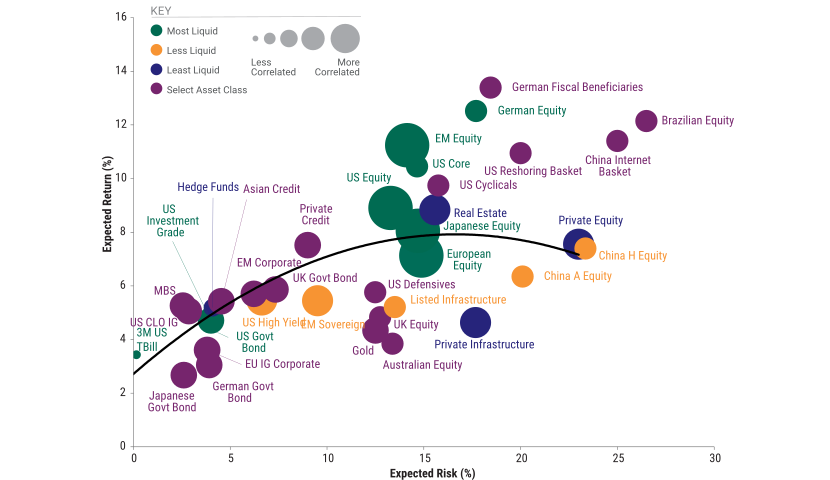
Please see Capital Market Line Endnotes. Note that the CML’s shape and positioning were determined based on the larger categories and do not reflect the subset categories of select asset classes, which are shown relative to other asset classes only.
Capital Market Line as of 31 March 2026 (USD View, Unhedged)
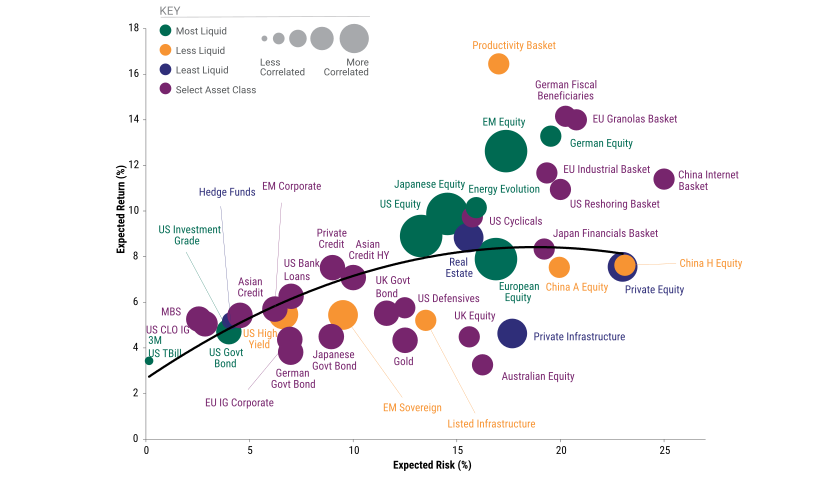
Please see Capital Market Line Endnotes. Note that the CML’s shape and positioning were determined based on the larger categories and do not reflect the subset categories of select asset classes, which are shown relative to other asset classes only.
Insights From Today’s CML
Our Capital Market Line (CML) has steepened a bit, yet it remains flat enough that the message is still one of dispersion, signifying both more winners and more losers ahead. This move is driven by powerful shifts in geopolitics, policy, and opportunity, as well as impending disruption. Technological progress has generally spawned more and larger winners and losers, and we see no reason to think AI will be any different. These dynamics are generating both risks and opportunities, fueling the current high dispersion. We expect this era of transformation to spur investment and to put upward pressure on real interest rates. Our approach is to capitalize on medium-term opportunities created by lasting technological and geopolitical changes that lead to structural upgrading of certain pockets in the market.
Equities: Focus on AI beneficiaries. While some believe AI stocks have peaked, we see spiking tokenization as the prelude to greater use of cloud services, with companies with defendable business models set to benefit. We also see agentics widening the gap between winners and losers within industries. With the US leading in AI, we would be cautious about underweighting the US. Instead, we are seeking AI beneficiaries that may have been dumped as fears of sector disruption indiscriminately took down likely winners along with likely victims. We are also focusing on long-tailed cyclical improvements in select financials, power-grid buildouts, and related metals. China’s edge in humanoid robotics may soon gain traction as well. In the UK, firmer London office rents and budget-driven tax hikes should keep rates drifting lower, supporting UK REITs, while a policy tilt toward nuclear power continues to benefit our New Energy basket.
Extend duration toward market norms. The rates curve has moved quickly to price in inflation as well as related policy hikes. The latter may not come, as rates must next price in an interim growth slowdown resulting from demand destruction. Fragile gilts are best positioned for this. We had been leery about longer duration, with markets not adequately pricing in the extent to which the upcoming investment waves are likely to drain the global savings glut; this would in turn raise real rates, particularly at the long end, after the recent backup as temporary oil inflation pulled expected policy rate cuts out of the forward curve. However, real rates are now fair, and we’re more open to extending duration back toward market norms. We have favored the belly of the curve, yet are starting to move out a bit.
Go where the issuance is not. Tight spreads and accelerating M&A look poised to erode investment grade (IG) credit’s edge over high yield (HY) bonds, with long-end investment-oriented supply poised to hit IG hardest. We expect modest widening in 2026 as the energy impact slows growth. We continue to favor Asian high yield (ex China property), yet we are now also interested in a handful of LatAm bonds.
Alternatives: From long-duration to gold to oil – and now back to longer duration. With real rates poised to trend higher, we have been diversifying our diversifiers. This more vibrant environment has also witnessed a move in stock-bond correlations from negative for the dozen or so years following the financial crisis to essentially zero (less diversifying) now. And with today’s balanced growth regime moving toward running hotter as various investment cycles kick in, stock-bond correlations should become progressively more positive (non-diversifying). We have been using gold as an alternative, given that its correlation to both stocks and bonds should become negative against that backdrop. Based on our research into how evolving regimes affect correlations, we spent much of the past two years removing duration at the long end of the curve and replacing it with gold. In March, with the risk that inflation would run hot temporarily amid the Iran conflict, we embraced Brent forwards at the expense of gold, with Brent having taken on a negative correlation to stocks, bonds, and gold. The Brent curve had also become particularly backwardated, offering a meaningful rollup return if spot prices stayed where they were. If a genuine de-escalation sets in, spots would decline but forwards much less so, yet stocks and bonds would do well. With the rocky transition toward a resolution underway, and long-end yields having priced in persistent rising inflation, we think it’s now time to dial back oil forwards as a diversifier and return to a blend of stocks, bonds, and gold.
The Fundamentals Driving Our CML
Transitioning toward a more balanced mix of public and private sector growth. After the global financial crisis, Western economies experienced a mild balance sheet recession, with weak consumption and investment as the private sector deleveraged. This was reinforced by unconventional monetary policy and largely passive fiscal support, leaving central banks to do most of the work. That “old abnormal” lasted until around 2015, after which growth improved alongside healthier household and corporate balance sheets. The post-pandemic surge in fiscal support was, in our view, a temporary and fragile form of US exceptionalism. The second Trump administration now appears intent on rebalancing growth by reducing government support and shifting momentum back to the private sector. While that adjustment may create near-term friction, we see it as necessary to build a more durable, investment-led growth backdrop. AI sits on top of this.
China is easing to offset anti-involution policies. China’s anti‑involution campaign has slowed consumption and private investment, creating the space for policy support. Policymakers now view a rising equity market as the preferred offset – channeling liquidity toward stocks while curbing excess capacity in traditional and advanced manufacturing. That’s easier said than done. In the absence of success on this metric, policy seems intent on managing the economic downside from ongoing pay cuts for highly paid employees of state-owned enterprises and allowing the real estate overbuilding to play out, so long as it doesn’t infiltrate the banking system. Both of these dynamics create a deflationary backdrop, which narrows wealth gaps – a consequence we believe the government favors. This China 2.0 appears to be using this domestic deflation to add to its natural export prowess, by managing the pace of yuan appreciation.
Europe is pulling the fiscal lever through Germany’s defense buildup. That said, the EU has only implemented 10% of Mario Draghi’s recommendations from the 2024 European competitiveness report. The Continent remains over-regulated for the competitive world it faces. Beyond Germany, other countries lack the debt capacity to pull growth along.
AI is shifting to application and deployment. AI is now moving from model buildout to real-world application and deployment, and that shift is increasingly disinflationary. As enterprise adoption broadens, AI should raise productivity, lower service costs, and put downward pressure on inflation over time. With AI moving from experimentation to enterprise deployment, the market focus is shifting from “pickaxe and shovel” beneficiaries to the real winners and losers of adoption. Platform players and companies that can embed AI into workflows should gain share, while narrower software and labor-intensive business models face growing pressure.
Capital Market Line Endnotes
The Capital Market Line (CML) is based on PineBridge Investments’ estimates of forward-looking five-year returns and standard deviation. It is not intended to represent the return prospects of any PineBridge products, only the attractiveness of asset class indexes, compared across the capital markets. The CML quantifies several key fundamental judgments made by the Global Multi-Asset Team for each asset class, which, when combined with current pricing, results in our annualized return forecasts for each class over the next five years. The expected return for each asset class, together with our view of the risk for each asset class as defined by volatility, forms our CML. Certain statements contained herein may constitute “projections,” “forecasts,” and other “forward-looking statements” which do not reflect actual results and are based primarily upon applying a set of assumptions to certain financial information. Any opinions, projections, forecasts, and forward-looking statements presented herein are valid only as of the date of this document and are subject to change. There can be no assurance that the expected returns will be achieved over any particular time horizon. Any views represent the opinion of the investment manager and are subject to change. For illustrative purposes only. We are not soliciting or recommending any action based on this material.
About the Capital Market Line
The Capital Market Line (CML) is a tool developed and maintained by the Global Multi-Asset Team. It has served as the team’s key decision support tool in the management of our multi-asset products. In recent years, it has also been introduced to provide a common language for discussion across asset classes as part of our Investment Strategy Insights meeting. It is not intended to represent the return prospects of any PineBridge products, only the attractiveness of asset class indexes compared across the capital markets.
The CML quantifies several key fundamental judgments made by the Global Multi-Asset Team after dialogue with the specialists across the asset classes. We believe that top-down judgments regarding the fundamentals will be the largest determinants of returns over time driving the CML construction. While top-down judgments are the responsibility of the Multi-Asset Team, these judgments are influenced by the interactions and debates with our bottom-up asset class specialists, thus benefiting from PineBridge’s multi-asset class, multi-geographic platform. The models themselves are intentionally simple to focus attention and facilitate a transparent and inclusive debate on the key drivers for each asset class. These discussions result in 19 interviews focused on determining five year forecasts for over 100 fundamental metrics. When modelled and combined with current pricing, this results in our annualized expected return forecast for each asset class over the next five years. The expected return for each asset class, together with our view of forward-looking risk for each asset class as defined by volatility, forms our CML.
The slope of the CML indicates the risk/return profile of the capital markets based on how the five-year view is currently priced. In most instances, the CML slopes upward and to the right, indicating a positive expected relationship between return and risk. However, our CML has, at times, become inverted (as it did in 2007), sloping downward from the upper left to the lower right, indicating risk-seeking capital markets that were not adequately compensating investors for risk. We believe that the asset classes that lie near the line are close to fair value. Asset classes well above the line are deemed attractive (over an intermediate-term perspective) and those well below the line are deemed unattractive.
We have been utilizing this approach for over a decade and have learned that, if our judgments are reasonably accurate, asset classes will converge most of the way toward fair value in much sooner than five years. Usually, most of this convergence happens over one to three years. This matches up well with our preferred intermediate-term perspective in making multi-asset decisions.
Disclosure
MetLife Investment Management (“MIM”), which includes PineBridge Investments, is MetLife, Inc.’s institutional investment management business. MIM is a group of international companies that provides investment advice and markets asset management products and services to clients around the world. The various global teams referenced in this document, including portfolio managers, research analysts and traders are employed by the various legal entities that comprise MIM.
All investments involve risk, including possible loss of principal; no guarantee is made that investments will be profitable. This document is solely for informational purposes and does not constitute a recommendation regarding any investments or the provision of any investment advice, or constitute or form part of any advertisement of, offer for sale or subscription of, solicitation or invitation of any offer or recommendation to purchase or subscribe for any securities or investment advisory services. The views expressed herein are solely those of MIM and do not necessarily reflect, nor are they necessarily consistent with, the views held by, or the forecasts utilized by, the entities within the MetLife enterprise that provide insurance products, annuities and employee benefit programs. The information and opinions presented or contained in this document are provided as of the date it was written. It should be understood that subsequent developments may materially affect the information contained in this document, which none of MIM, its affiliates, advisors or representatives are under an obligation to update, revise or affirm. It is not MIM’s intention to provide, and you may not rely on this document as providing, a recommendation with respect to any particular investment strategy or investment. Affiliates of MIM may perform services for, solicit business from, hold long or short positions in, or otherwise be interested in the investments (including derivatives) of any company mentioned herein. Views may be based on third-party data that has not been independently verified. MIM does not approve of or endorse any republication of this material. This document may contain forward-looking statements, as well as predictions, projections and forecasts of the economy or economic trends of the markets, which are not necessarily indicative of the future. Any or all forward-looking statements, as well as those included in any other material discussed at the presentation, may turn out to be wrong.

Multi-Asset
Explore PineBridge’s world-class multi-asset solutions
Recent Insights